Technologies in Reproductive Screening and Diagnosis SIG Update
Natalie Chandler, FRCPath, PhD
Francesca Romana Grati, MSCs, PhD
Co-Chairs, Technologies in Reproductive Screening and Diagnosis SIG
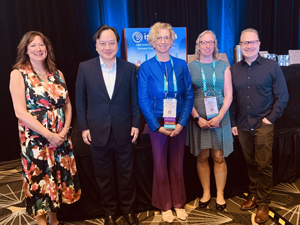
The Technologies in Reproductive Screening and Diagnosis Special Interest Group met at the ISPD conference in Boston. Thank you to those who attended the meeting (whether in person or virtually). The session started with a talk from Prof. Brynn Levy on the clinical implementation of short-read nanopore sequencing for rapid aneuploidy detection which has been published in the New England Journal of Medicine. The next talk was from Prof. Sandi Deans who gave an update on the EQA schemes offered by GENQA that are relevant to the prenatal community. Finally, we were privileged to have a talk from Prof. Dennis Lo on his groups pioneering work on cfDNA fragmentomics. There were also many other relevant sessions for the SIG throughout the conference including two lively debates on cytogenetics being a dinosaur (about to be published on-line) and whether all fetuses undergoing fetal therapy should have exome sequencing. There were also two well attended technology-based preconference courses on fetal sequencing and the current and future directions of NIPT. We are looking forward to our next meeting in Cape Town in October.
In recent years there has been a rapid expansion in the sequencing technologies coming to market. These include sequencers with high accuracy, longer sequencing reads and sequencers capable of doing multi-omics on the same platform. These technologies have great potential for advancement of both invasive and non-invasive prenatal testing and we are excited to follow how these technologies are implemented.
Recently a number of countries have published national statements on the use of sequencing for fetuses with structural anomalies including Belgium, France and Denmark. ISPD is currently working with European Society of Human Genetics to prepare international recommendations on the use of sequencing technologies in fetuses which should be published later this year. There has also been a rapid surge in the last year in the number of publications related to the use of fetal sequencing in fetuses with no structural anomalies. A recent issue in the Prenatal Diagnosis journal (Prenatal Diagnosis: Vol 45, No 3) has several articles on this area discussing the yield, along with the challenges that need to be addressed.
Another key paper (PMID: 39871067) presents best practice recommendations from the Italian Society of Human Genetics (SIGU) to guide specialists in managing pregnancies resulting from preimplantation genetic testing (PGT). The paper provides diagnostic algorithms for prenatal genetic follow-up, tailored to the type of PGT performed: PGT for monogenic diseases (PGT-M), PGT for chromosomal structural rearrangements (PGT-SR), and PGT for aneuploidies (PGT-A). These algorithms are based on PGT results and their diagnostic value, which reflects how effectively PGT predicts the embryo's actual genetic status and potential pregnancy outcomes. Factors influencing diagnostic value include test accuracy, the presence of mosaicism, the type of genetic abnormality detected, and its clinical significance, all of which inform subsequent prenatal genetic management.