Journal Club Recap:
Genome-Wide Cell-Free DNA Analysis for Aneuploidy Detection in Miscarriages: Test Performance Meta-Analysis
Kirsten Niles, MD, PhD
On 25 March 2026, ISPD members had the opportunity to join the ISPD Journal Club reviewing the publication, Genome-Wide Cell-Free DNA Analysis for Aneuploidy Detection in Miscarriages: Test Performance Meta-Analysis, by Pauta et al., presented by senior author Dr. Antoni Borrell.
The impact of pregnancy loss prior to 22 weeks' gestation is profound on those it affects. Understanding the etiology of the pregnancy loss can provide information that can modify the care of future pregnancies, but also can help reduce the psychological consequences of loss for the family. Chromosomal abnormalities are a frequent cause of pregnancy loss, accounting for 50-70% of cases. Access to confirmation of a chromosome abnormality, however, can be limited by the availability of adequate tissue for testing, particularly in medical uterine evacuation. The alternative, parental karyotype, cannot confirm de novo events.
The advent of genome-wide cell-free DNA (cfDNA) technologies for aneuploidy screening in pregnancy altered the prenatal screening landscape. Its performance as a screening test for aneuploidy in pregnancy loss is still being evaluated and may be impacted by the cfDNA platform, gestational age at the time of loss, timing of blood sample acquisition, and specific chromosome abnormality.
An early pilot study in 2015 by Clark et al (PMID: 26000503) evaluated 37 pregnancy loss cases between 5-22 weeks gestation with 10/37 (27%) resulting in no call. This suggested limited utility for cfDNA in pregnancy loss. In 2020, Yaron et al (https://doi.org/10.1093/humrep/deaa073) evaluated cfDNA assessment in pregnancy losses between 5-12 weeks gestation and demonstrated a lower rate of no call 2/109 (1.8%) with relatively robust concordance (73/84, 87%) with another form of diagnostic testing (qfPCR and karyotype). Multiple studies have now evaluated the use of cfDNA to identify aneuploidy in pregnancy loss.
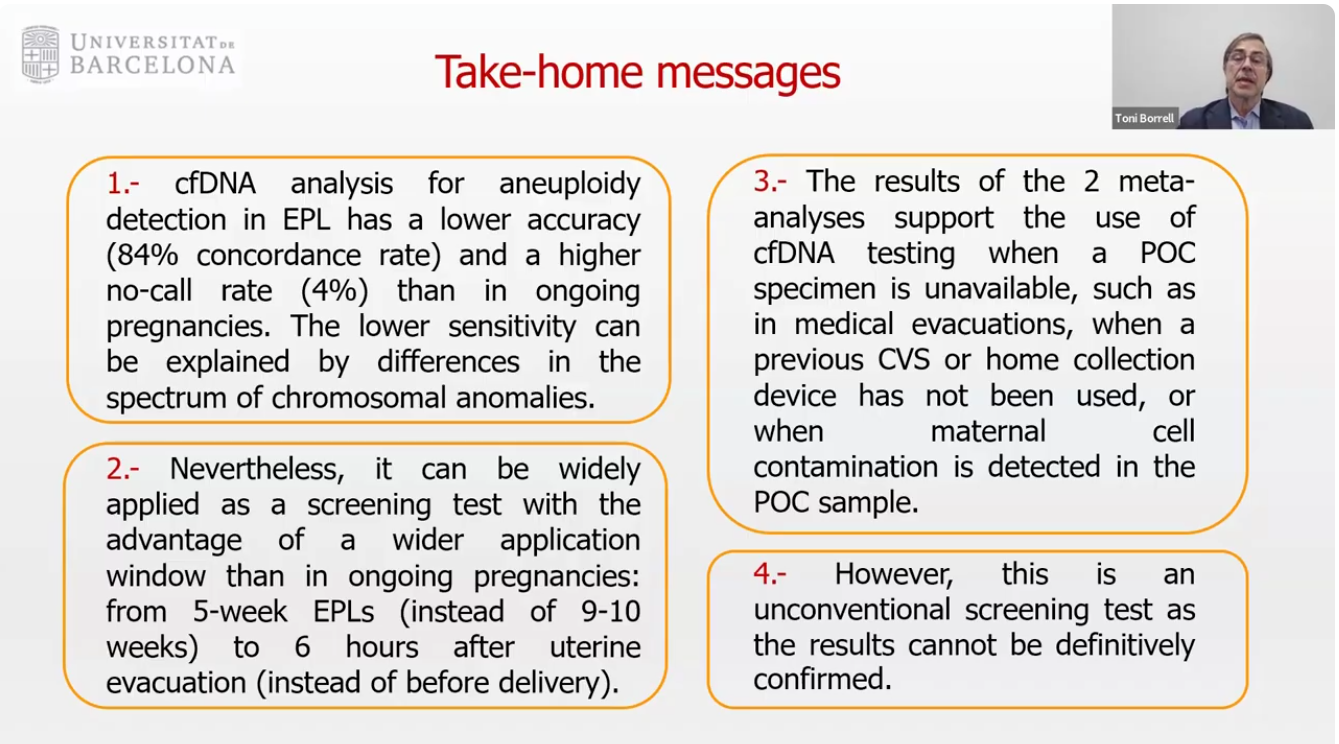
The Pauta et al meta-analysis assembled data from eight studies in which cfDNA results were compared to confirmatory diagnostic testing in pregnancy loss between 5-22 weeks gestation with the aim of evaluating the performance of genome-wide cfDNA testing in the detection of fetal aneuploidy in pregnancy loss. Sample size of the studies included ranged from 10-222 cases. The pooled aneuploidy rate, no call rate, and concordance was 61% (95% CI: 53-69%), 4% (95% CI: 0-12%), and 84% (95% CI: 81-87%) respectively. As a screening test, the pooled sensitivity, specificity, and AUC of cfDNA for detection of aneuploidy in pregnancy loss was 78% (95% CI: 71-83%), 91% (95% CI: 86-95%), and 92% respectively. The likelihood ratio of a positive cfDNA result was 9 resulting in a post-test probability of aneuploidy of 93%. Conversely, a negative cfDNA result has a likelihood ratio of 0.25 leading to a post-test probability of aneuploidy of 28%. The authors concluded that given the performance parameters identified, cfDNA could be utilized as a screening test for aneuploidy in pregnancy loss to provide information regarding the likely etiology to families as well as direct additional investigations for alternative causes of pregnancy in those with a negative test.
Discussion of this study centered on the access to cfDNA testing in the context of a pregnancy loss, particularly with regards to payment. As part of this discussion, a potential area of future study is a cost analysis of the use of cfDNA screening in pregnancy loss. Evaluation for non-aneuploidy causes of pregnancy loss can be costly and often have a low yield, particularly as aneuploidy underpins approximately 61% of pregnancy losses. Targeting those with a negative cfDNA screen could be a cost-effective solution that could encourage the incorporation of cfDNA into pregnancy loss evaluation protocols that are supported by insurance.
To hear the full presentation and discussion, ISPD members can sign in to watch the full March 25, 2026, Journal Club here.