Technologies in Reproductive Screening and Diagnosis SIG Update
Natalie Chandler, FRCPath, PhD
Ieva Miceikaite, PhD
Co-Chairs, Technologies in Reproductive Screening and Diagnosis SIG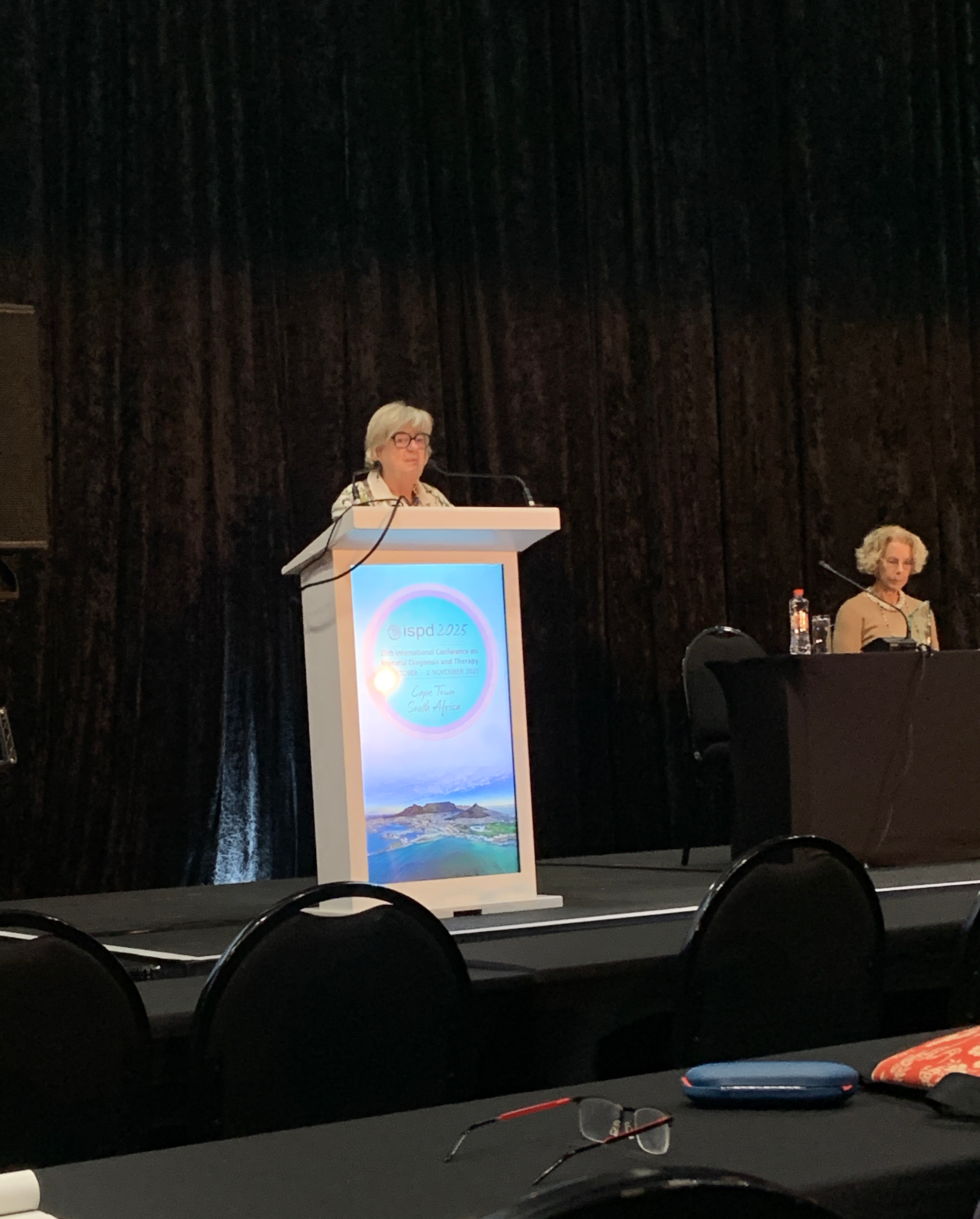
Firstly, we would like to take this opportunity to express our sincere thanks to Dr. Francesca Romana Grati for her outstanding dedication as SIG Co-chair from 2019-2025. Her leadership, expertise, and commitment have been invaluable to the SIG and to ISPD as a whole, and we are grateful for her many contributions.
The Technologies in Reproductive Screening and Diagnosis Special Interest Group met at the ISPD 2025 conference in Cape Town. Thank you to all those who attended the breakfast meeting, whether in person or virtually. We started the session with a talk from Prof. Sandi Deans who gave an update on the EQA schemes offered by GENQA that are relevant to the prenatal community. The session also featured talks from submitted abstracts. Mio Aerden (Belgium) presented on cfDNA properties in healthy individuals with implications for pregnancy screening (https://link.springer.com/article/10.1186/s13073-026-01618-w ), followed by lightning talks from Peter Benn (USA) on identifying complete hydatidiform mole and a co-existing fetus through prenatal SNP-based cell-free DNA screening (https://obgyn.onlinelibrary.wiley.com/doi/10.1002/uog.70144), and from Morten Nielsen (Denmark) on cell-based non-invasive prenatal testing using genome sequencing. Local speakers Gloudi Agenbag and Rita Labuschagne rounded off the session with their experience of non-invasive prenatal testing in South Africa.
The ISPD 2025 conference featured a rich program with many sessions relevant to our SIG. The use of sequencing technologies to detect monogenic conditions prenatally both invasively and non-invasively remains a key topic. There were exciting discussions regarding fetal therapies for monogenic conditions such as SMA and a presentation from Pioneer Award winner Professor Dame Lyn Chitty on the potential of sequencing technologies in relation to therapy that also highlighted the challenges that need to be addressed. Two key themes dominated the discussions across the conference. The first is what is actually analyzed (and reported) when exome or genome sequencing is offered prenatally. The second, screening for monogenic disorders in non-anomalous pregnancies including a lively debate on whether genome sequencing should be the first-line genetic testing modality.
In relation to the second, there has been a notable surge in publications reporting on sequencing in pregnancies with no fetal structural anomalies as summarized in a systematic review last year (Incremental yield of exome sequencing over standard prenatal testing in structurally normal fetuses: systematic review and meta-analysis - PubMed) with a pooled incremental diagnostic yield of 1.6%.  There is also a surge in publications on non-invasive sequencing of cell-free DNA (cfDNA) for monogenic conditions (Liao et al.; PMID: 39865331; https://obgyn.onlinelibrary.wiley.com/doi/10.1002/pd.6752 ) with technical developments moving from panel approaches to proof-of-concept studies on exome and genome sequencing. It is now clear that analytical validity is rapidly improving, offering a vision for a future where in some cases invasive procedures may be reserved for confirmation rather than primary diagnosis. However, whether invasive or non-invasive, there remain significant challenges to be addressed. What conditions should we test for? What variants should be reported? How do we classify and determine the penetrance of the variants without a phenotype? How do we counsel patients undergoing this testing (see commentary: Navigating the Challenges of Exome Sequencing in Structurally Normal Fetuses - Langlois - 2025 - Prenatal Diagnosis - Wiley Online Library). The ISPD Board has acknowledged the need for a position statement on this area, and this is on the agenda for the upcoming year. Meanwhile, we look forward to continuing these discussions at this year’s virtual ISPD 2026 conference.
If the debates above sound relevant, we would like to direct your attention to two forthcoming special issues of ISPD’s official journal Prenatal Diagnosis that are being published in May on “Fetal sequencing: What have we learnt and where are we going”, which may carry some answers. Highlights include two studies calling for global standardization in approaches to sequencing (https://obgyn.onlinelibrary.wiley.com/doi/full/10.1002/pd.6866) and bioinformatics (https://obgyn.onlinelibrary.wiley.com/doi/full/10.1002/pd.70085), issues ISPD is currently working to address, alongside a commentary on the critical role of clinical acumen when sequencing alone is not enough, particularly in time-pressured scenarios (https://obgyn.onlinelibrary.wiley.com/doi/10.1002/pd.70051). Further highlights include two comparative studies on gene panel versus exome sequencing (Swanson et al., 2026, https://doi.org/10.1002/pd.70118; Ardiles-Ruesjas et al., 2026, https://doi.org/10.1002/pd.70066), the most comprehensive updated systematic review to date of diagnostic yield across fetal structural anomalies (Lim et al., 2026, https://doi.org/10.1002/pd.70112), and insights into the implications of postnatal reanalysis of prenatal results (Swanson et al., 2025, https://doi.org/10.1002/pd.6886). The issues also cover sequencing in the largest cohort of structurally normal pregnancies, the role of sequencing in fetal therapy decisions, yield data across specific anomaly groups, implementation experiences from across the globe, and efforts to improve parental understanding of these complex tests. We hope you find something that challenges your thinking and enriches your practice.
Finally, the SIG co-chairs would like to thank the ISPD members that provided feedback on the joint ISPD-European Society of Human Genetics global recommendations for the use of diagnostic genomic testing in the prenatal setting. The manuscript is in the final stages of the review process and will be published later this year.